WeOrthodox
EN UA

Kyle

YouTube 7 discussions · Open the original ↗

ꜱᴜʙꜱᴄʀɪʙᴇ ꜰᴏʀ ᴍᴏʀᴇ!

Kyle YouTube discussion

Is the Holy Fire a Hoax? An Orthodox Response to a Catholic Attack

Is the Holy Fire a Hoax? An Orthodox Response to a Catholic Attack 21:19

This video responds to a Catholic apologetics video titled 'Orthodoxy's greatest miracle is a lie,' which attacks the annual Holy Fire ceremony in Jerusalem. The speaker's central argument is that the Holy Fire is not dogma: even if it were shown to be naturally lit, Orthodoxy would not thereby be disproved, just as a false Marian apparition would not disprove Catholicism.

He walks through the history and meaning of the ceremony, in which the Patriarch of Jerusalem enters Christ's tomb on Holy Saturday and light is distributed to thousands of candles, and cites ancient documentation from Eusebius, Gregory of Nyssa, Egeria, the Armenian lectionary, St. John of Damascus, Bernard the Monk, Muslim sources, and the 1579 column-splitting account.

He rebuts specific claims about natural ignition, website wording changes, and a reported 2026 Greek court ruling, arguing that a civil court cannot settle theological questions and that natural ignition would not make the fire a hoax, since blessed things like holy water can become holy through prayer. The heart of the video is a warning against building faith on a 'scoreboard of miracles': Scripture commands testing signs, false prophets can work wonders, and chasing miracles sets people up for deception by the Antichrist.

The real question, he argues, is which church preserves the apostolic tradition of the first millennium. The comment section complicates the picture: several Orthodox commenters agree the Fire is not magic and note hierarchs are not infallible, but others press a sharper critique—that if clergy have knowingly overstated the miracle for generations, this raises questions of institutional integrity and trust, which is the real point of the Catholic criticism rather than a claim that a false fire disproves Orthodoxy outright.

  • The Holy Fire is not dogma; even if naturally lit, Orthodoxy would not be disproved, just as false apparitions would not disprove Catholicism.
  • The ceremony is anciently documented: Eusebius, Gregory of Nyssa, Egeria, John of Damascus, Muslim sources, and the 1579 account.
  • Natural ignition would not make it a hoax—blessed things can become holy through prayer, like holy water.
  • Faith must not rest on a scoreboard of miracles; Scripture commands testing signs, and the Antichrist will perform wonders.

Key moments: 0:001:332:05

Kyle YouTube discussion

Where Was the Protestant Church Before 1500? A Case for Orthodox Indefectibility

Where Was the Protestant Church Before 1500? A Case for Orthodox Indefectibility 28:50

This video presents what the speaker calls a decisive argument against Protestantism: the impossibility of locating a visible, continuous Protestant church in any century before the Reformation. The argument begins not with contested doctrines, where both sides can quote Scripture and the Fathers indefinitely, but with the deeper question of what Christ established at Pentecost and what became of His Church.

The New Testament, the speaker argues, presents the Church as Christ's body, the pillar and ground of truth, promised the Holy Spirit and protection from the gates of Hades—not an invisible collection of believers. Early Fathers such as Irenaeus, Clement, Cyprian, Athanasius, and Augustine teach the Church's indefectibility and apostolic succession through the episcopate.

The sharpest dilemma concerns practices the Reformation rejected: invocation of saints, relics, icon veneration, and especially monasticism, which the Church venerated as a model of holiness for over a millennium. Either the Spirit guided the Church through those centuries, or the Reformation corrected it—but not both. The speaker rejects the Old Testament analogy of restoration, noting that Israel's reformers worked within a living covenant people, and points to St. John Chrysostom and St. Maximus the Confessor as reformers who suffered injustice within the Church rather than founding new ones.

The comment section became a substantive debate: Protestants objected that the argument conflates the Church as Christ's body with institutional infallibility, cited Acts 20's warning that even Spirit-appointed overseers can err, and noted that the Reformers claimed succession through the Western church rather than being restorationists.

Others listed pre-Reformation dissenters like Wycliffe and Hus as a Protestant 'succession,' while supporters cited 2 Thessalonians 2:15 on tradition and apostolic succession. One inquirer described the argument as the strongest version he had heard, while questioning whether the conclusion fully follows.

  • The core argument: no visible, continuous Protestant church can be identified before the 1500s, while the New Testament and Fathers describe an indefectible, visible Church.
  • Practices rejected at the Reformation—saints, relics, icons, monasticism—were universal for over a millennium, posing a dilemma about the Spirit's guidance.
  • Chrysostom and Maximus model reform from within the Church, not schism from it.
  • Commenters pushed back: institutional infallibility is assumed rather than proven, and the Reformers claimed succession through the Western church, not restoration.

Key moments: 0:001:022:34

Kyle YouTube

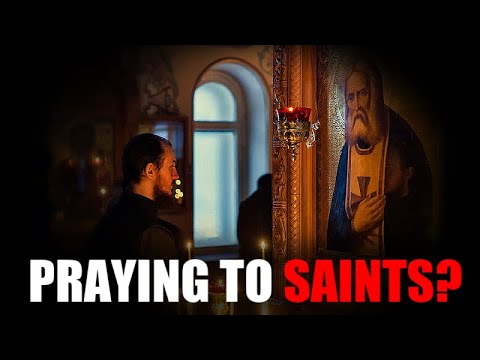
Why Orthodox Christians Ask the Saints to Pray for Them

Why Orthodox Christians Ask the Saints to Pray for Them 11:18

This video offers a defense of the Orthodox practice of asking the saints for their intercession, responding to common Protestant objections that it amounts to worship or detracts from Christ. The speaker argues that 'prayer' in this context simply means a request: asking a saint to pray for us is no different from asking a fellow Christian on earth to do the same.

He grounds the practice in Scripture, citing the powerful intercessions of Abraham, Moses, and Mary, and pointing to Revelation, where the saints in heaven actively pray for those on earth while incense is offered. Because the saints are partakers of the divine nature and dwell with Christ, who is the God of the living and not the dead, their prayers are understood as especially efficacious, with the Theotokos holding the highest place of honor.

The video also addresses difficult phrases from Orthodox hymnography, explaining that calling Mary the 'gate of salvation' refers to salvation entering the world through her womb, and that 'Most holy Theotokos, save us' means 'save us through your prayers'—not that Mary is a savior in Christ's place. Historical evidence is presented as well: ancient liturgies of St. Mark, St. John Chrysostom, and St. Basil, along with the account of Polycarp's martyrdom, show that belief in the saints' intercession and veneration of relics go back to the earliest Church.

The speaker notes that organized opposition to the practice arose only with the Protestant Reformation, arguing that such a late break implies a denial of the Holy Spirit's guidance of the Church through the centuries. The overall thrust is that venerating the saints does not diminish God's glory but recognizes His glory at work in His people, and that salvation is communal rather than purely individual.

  • Asking saints to pray for us is a request, not worship—just like asking living Christians to pray for us.
  • Scripture shows the prayers of the righteous are powerful: Abraham, Moses, Amos, and Mary all interceded effectively.
  • Revelation depicts the saints alive in heaven, praying for the faithful with incense, which Orthodox worship preserves.
  • Hymn phrases like 'Theotokos, save us' mean 'save us through your prayers'; no Orthodox teaching makes Mary a savior.

Key moments: 0:020:321:03

Kyle YouTube

Christ Blesses Peacemakers, Not Peacekeepers: Why Suppressing Conflict Is Not Peace

Christ Blesses Peacemakers, Not Peacekeepers: Why Suppressing Conflict Is Not Peace 16:12

This video draws a sharp distinction between peacekeeping and peacemaking in the Christian life. The speaker argues that modern culture equates peace with the mere absence of conflict, but Christ blesses peacemakers, not peacekeepers. True peace is not the quieting of a dispute but reconciliation rooted in truth, repentance, forgiveness, and communion with God.

When we play the peacekeeper—saying 'peace, peace' when there is no peace—we only push resentment beneath the surface, where it festers. Genuine peacemaking, by contrast, often requires walking into uncomfortable conversations, following Christ's command to go to our brother alone when he has sinned against us, and to be reconciled before offering our gift at the altar.

A substantial portion of the talk focuses on what makes a real apology. Empty words, defensiveness, excuses, and repeated apologies that produce no change are not true repentance; they are simply a way of making ourselves feel better. The speaker offers practical guidance: acknowledge what you did, take full responsibility without excuses, understand the impact on the other person, express genuine repentance, and commit to change—and do it today, in light of the daily remembrance of death.

The video also warns against self-righteous confrontation. Correction must flow from humility and love, not from a desire to win; one must remove the plank from one's own eye first, listen before speaking, and be willing to say the words pride hates most: 'Forgive me.' Discernment for such conversations, the speaker stresses, comes only from a life of prayer, confession, and the Eucharist.

The discussion culminates in the point that Christ himself is our peace: before we can have peace with one another, we need peace with God through repentance, confession, and forgiveness. The Christian life is presented as a lifelong spiritual battle in which we make peace by entering conflict with humility, truth, and love.

  • Christ blesses peacemakers, not peacekeepers—true peace is reconciliation in Christ, not the mere absence of conflict.
  • Suppressing conflict with a superficial 'peace, peace' leaves resentment festering beneath the surface.
  • Real apologies take responsibility without excuses and lead to actual change, not just words that make us feel better.
  • Confrontation must be done with humility and discernment—remove the plank from your own eye first, and speak the truth in love.

Key moments: 0:002:062:38

Kyle YouTube

The Battle Between Good and Evil Runs Through Your Own Heart, Not Against Other People

The Battle Between Good and Evil Runs Through Your Own Heart, Not Against Other People 11:31

This video challenges the common tendency to reduce Christianity to an ideology of 'us versus them.' The speaker argues that the true battlefield is within one's own heart, and that awareness of one's own sins—weeping over them—is the foundation of Christian life. Repentance, in this view, is a full-time occupation, not a hobby.

From there, the video explores how early Christians converted the world: not through argument, but through radical love and good deeds. A striking example is the story of a monk who, when robbed, offered his remaining belongings to the robber—an act of generosity that led the thief to repentance and eventual sainthood. The speaker cites patristic teaching that one compassionate deed accomplishes more than hours of debate with atheists or the embittered, since it is the devil, not the person, who provokes conflict; a meek deed is like water poured on fire.

The discussion then turns to the Protestant Reformation. The reformers, the speaker contends, were primarily polemicists rather than ascetics: they rejected Catholic authority and replaced it with private interpretation of Scripture, but discarded monasticism and asceticism—the very practices that cultivate holiness and discernment.

Henry VIII's dissolution of the monasteries is cited as emblematic. Luther's rage, Calvin's moralistic rule in Geneva, and the absence of saints among the reformers are contrasted with Orthodoxy's understanding that only three saints—John the Theologian, Gregory the Theologian, and Simeon the New Theologian—bear the title 'theologian,' because their words flowed from direct experience of God rather than academic study.

Finally, the video addresses troubling episodes in the lives of saints, such as St. Nicholas striking Arius, explaining that such zeal arose from purified hearts and divine love. Ordinary believers should imitate the saints' humility and spirit—not their dramatic actions—and begin their own path to holiness with repentance.

  • Christianity is not an ideology of 'us versus them'; the line between good and evil runs through every human heart, making repentance a full-time job.
  • Early Christians won converts through radical love and deeds, as when a robbed monk's generosity led his robber to repentance and sainthood.
  • One compassionate deed persuades atheists and the embittered more than hours of debate, since the devil—not the person—provokes conflict.
  • The Protestant reformers were polemicists, not ascetics: they discarded monasticism and produced systems and division rather than saints.

Key moments: 0:001:032:08