WeOrthodox
EN UA

Holy Resurrection

YouTube 13 discussions · Open the original ↗

Holy Resurrection is a YouTube channel of the Holy Resurrection Serbian Orthodox Church in Lebanon PA USA. Our Parish is part of the Eastern Diocese of the Serbian Orthodox Church in America. Contact: o.borjan@gmail.com https://www.buymeacoffee.com/holyresurrection Visit this Store:…

Holy Resurrection YouTube

St. Paisios on Mobilizing Prayer to Avert War and Heal the Heart

St. Paisios on Mobilizing Prayer to Avert War and Heal the Heart 6:16

The post shares excerpts from St. Paisios the Athonite’s Spiritual Counsels on prayer, focusing on the Elder’s urgent call for fervent intercession to prevent war and calamity. He recounts a spiritual assurance to pray intensely that a Turkish attack be restrained, giving thanks to the Theotokos for protection. St. Paisios teaches that all people are brothers by descent from Adam and Eve, but Orthodox Christians share a deeper spiritual bond, compelling them to pray with greater pain for those suffering.

He clarifies that prayer is not a mechanical guarantee of national salvation but an expression of heartfelt sorrow that invites God’s intervention. The Elder calls for spiritual warriors like the Maccabees, urging monastics to prioritize prayer above all tasks because the world is in turmoil. He explains that passions — pride, self-will, shamelessness — act like rusted wires that short-circuit communion with God.

Using a radio analogy, he illustrates that to communicate with God we must tune our transmitter to love and our receiver to humility, laboring to acquire divine contact so the mind remains continually with God.

  • The Elder mobilized prayer from spring to autumn to avert war, receiving assurance to pray fervently for restraint of a Turkish attack on October 16th.
  • All humans are brothers in flesh; Orthodox Christians are brothers in both flesh and spirit, so we must pray for others with deeper pain.
  • Prayer is not a mechanical guarantee of salvation but an expression of heartfelt pain that seeks God’s intervention.
  • Monastics must set aside urgent tasks and devote all strength to prayer, as their purpose is the salvation of souls and helping the world.

Key moments: 0:001:031:34

Holy Resurrection YouTube

St. Nikolaj Velimirović on the Miraculous Catch: All Labor Is Vain Without Christ

St. Nikolaj Velimirović on the Miraculous Catch: All Labor Is Vain Without Christ 6:56

This post shares an excerpt from St. Nikolaj Velimirović's homily for the 18th Sunday after Pentecost, focusing on the Gospel account of the miraculous catch of fish (Luke 5:1–11). The saint reflects on the nature of miracles as divine gifts given to awaken humanity from the spiritual dullness caused by sin. In paradise, every moment would be perceived as a miracle, but sin has made God's constant providence seem like mere habit.

To rouse us, God grants extraordinary signs — like the catch of fish — that reveal His sovereignty over creation and our total dependence on Him. St. Nikolaj emphasizes that human wisdom, labor, and enterprise are utterly fruitless apart from God's blessing. He contrasts the Tower of Babel, a monument to human pride that was scattered, with the Church and monasteries, which endure because they are built by God.

The Gospel scene illustrates this perfectly: the disciples toiled all night and caught nothing, but at Christ's word their nets broke with fish. The lesson is clear: obedience to Christ, not human effort alone, brings true success. The post also includes a brief appeal for monthly support to build a parish church, framing even that material project as a work that must be founded in the heart and blessed by God.

  • Miracles are divine gifts given to awaken humanity from spiritual blindness caused by sin.
  • Human labor and wisdom produce nothing good without God's blessing and command.
  • The Tower of Babel exemplifies the futility of human projects opposed to God's will.
  • The Church and her institutions endure because they are God's work, not man's.

Key moments: 0:060:381:10

Holy Resurrection YouTube

Love of Neighbor: The Visible Field of Love for the Invisible God

Love of Neighbor: The Visible Field of Love for the Invisible God 7:02

This post presents an excerpt from a homily by St. Nikolaj Velimirović on the 15th Sunday after Pentecost (Matthew 22:35–46), explaining why Christ calls the second great commandment—love your neighbor as yourself—like unto the first. The homily argues that the two commandments are inseparable because love for God naturally overflows into love for His creatures, just as love for one's mother strengthens love for one's siblings.

Whoever loves God easily loves human beings as his brothers in God; whoever does not love God can only deceive himself about loving others, possessing at best a vague pity rooted in self-pity. Christ expanded the meaning of neighbor beyond one's own people to all mankind and gave a new commandment to love one another as He loved us—new because spoken by Him who manifested the greatest love, even commanding love for enemies, since God shines on both the good and the evil, leaving judgment to Him alone.

Neighbors are described as the visible field on which we show love for the invisible God; God is moved by our love for neighbors as a mother is moved by a stranger's kindness to her child. The apostle John's warning that whoever claims to love God while hating his brother is a liar underscores that neighbors are a school training us in the perfect love of God.

The homily enumerates the chief works of love—mercy, forgiveness, prayer for others, supporting the weak, instructing the ignorant, defending the oppressed—and closes with the image of the faithful as members of one body in Christ, called to assist one another's growth, since when one member prospers or suffers, the whole body shares in it.

The post accompanies a video presentation of the homily and includes parish support links; no substantive discussion appears in the comments.

  • The second commandment is like the first: love for God naturally extends to love for His creatures as brothers.
  • Without love of God, supposed love of others is at best self-pity; the apostle John calls such a person a liar.
  • Christ's command to love enemies is new because He manifested the greatest love; judgment belongs to God alone.
  • Neighbors are the visible field where love for the invisible God is shown; the chief works of love are mercy, forgiveness, prayer, and defense of the oppressed.

Key moments: 0:120:431:15

Holy Resurrection YouTube

An Orthodox Catechism, Part 3: The Person of Christ

An Orthodox Catechism, Part 3: The Person of Christ 1:05:38

This post shares the third installment of an ongoing Orthodox catechism series based on "The Life" by Dr. Clark Carlton, hosted by a priest associated with Holy Resurrection parish. This session focuses on the Person of Christ: who Christ is to the faithful Orthodox Christian, what He has done for us, and why His work was necessary for our salvation.

It also considers the revelation given to us in the account of His dwelling among us — the mystery of the Incarnation as the foundation of Christian faith and life. The series is presented as a set of recorded lectures, with the full collection available as a podcast for those who wish to follow the entire catechism from the beginning.

Alongside the lecture, the post includes the parish's ongoing appeal for building a future church home, framed with the reflection that "every temple is built first in the heart" and that small, steady offerings given in faith become a quiet work of grace. Readers are invited to become monthly supporters or give one-time gifts toward the building fund.

The post also lists various ways to support the channel and parish ministry, including memberships, patronage, a shop, and written work by the priest. There is no discussion in the comments; the post stands as a straightforward announcement and invitation to learn. For those seeking a structured introduction to Orthodox teaching on Jesus Christ — His person, His saving work, and what His coming among us reveals — this lecture offers an accessible entry point within a broader, orderly course of catechetical instruction rooted in Orthodox tradition and Scripture.

  • Third class in a catechism series based on "The Life" by Dr. Clark Carlton
  • Topic: the Person of Christ — who He is, what He has done, and why it was necessary for us
  • Considers the revelation of Christ's dwelling among us (the Incarnation)
  • Full lecture series available as a podcast
Holy Resurrection YouTube

How Can We Be Called Christians If We Have Nothing of Christ Within Us?

How Can We Be Called Christians If We Have Nothing of Christ Within Us? 7:40

This post presents a penitential homily drawn from St. Maximus the Confessor's 'Discourse on the Ascetic Life' (chapters 31–34), as found in the Russian edition of his Selected Works translated by A. I. Sidorov.

The homily is a sober examination of conscience: it laments that Christians who have received God's grace often live in negligence and vice, and asks pointedly how we can bear the name of Christ while having nothing of Christ within us. The speaker weaves together the voices of Scripture—Jeremiah's fountain of tears, Moses' warning that Jacob grew fat and forsook God, Micah's mourning that the godly man has perished from the earth, the Psalmist's 'there is none who does good,' and the Apostle Paul's prophecy to Timothy about lovers of self and money in the last days—showing that these ancient laments are fulfilled in us today.

The heart of the message is that by living according to the flesh rather than the Spirit, we forfeit the name of sons of God and become temples of evil instead of temples of God. Like the Jews who claimed God as their father but were told 'you are of your father the devil,' we risk the same rebuke if we transgress the commandments.

True children of God are led by the Spirit and bear its fruits—love, joy, peace, longsuffering—while faith without works is dead, for 'even the demons believe and tremble.' Those in whom Christ truly lives bless those who revile them; those who act against His commandments make of themselves a den of thieves instead of a house of prayer.

The post also includes appeals to support the building of a parish church and links to the channel's other resources.

  • St. Maximus the Confessor's homily asks how we can bear Christ's name while lacking anything of Christ within us.
  • Old Testament laments—Jeremiah, Moses, Micah, the Psalms—and Paul's prophecy of the last days are shown to be fulfilled in negligent Christians today.
  • Living by the flesh rather than the Spirit makes us temples of evil instead of temples of God and forfeits the name of sons of God.
  • Faith without works is dead: true believers bear the fruits of the Spirit and bless those who revile them.

Key moments: 0:120:431:14

Holy Resurrection YouTube

The Eight Passions and Eight Virtues: A Catechism with St. John Cassian and St. Ignatius Brianchaninov

The Eight Passions and Eight Virtues: A Catechism with St. John Cassian and St. Ignatius Brianchaninov 1:21:24

This post presents a recorded Orthodox Christian catechism lecture continuing a parish's series through 'The Field' by St. Ignatius Brianchaninov. The lecture's central teaching concerns the classical ascetical scheme of eight chief passions and their contrasting eight chief virtues, a framework the Orthodox spiritual tradition received from St. John Cassian the Roman, whose writings shaped monastic teaching on the struggles of the soul.

The post poses the question directly to the reader: what are these eight passions and virtues? It also takes up the related spiritual question of what the love of God actually is, suggesting the lecture treats love not merely as feeling but as the fruit of the purified heart and the crown of the virtues. The content is a lecture rather than a debate; no replies are shown, so it stands as teaching material for those following the series or seeking an introduction to Orthodox ascetical theology.

The post combines the lecture with parish life: it invites listeners to support the building of a church home, framing even a small monthly gift as 'a quiet work of grace' offered in faith, since 'every temple is built first in the heart.' Links are provided for ongoing and one-time giving, the parish's online shop, a newsletter, and the speaker's other channels, including a Spotify feed with more lectures.

For a reader deciding whether to open it, the card offers a compact entrance into the traditional eightfold analysis of the passions and the virtues that heal them, presented in an accessible lecture format rooted in St. Ignatius Brianchaninov's compendium of Orthodox spirituality. The post closes with a blessing: 'May Christ bless you and your household.'

  • Catechism lecture continuing a series through St. Ignatius Brianchaninov's 'The Field'.
  • Teaching based on St. John Cassian's eight chief passions and their contrasting eight chief virtues.
  • The lecture also addresses the question: what is the love of God?
  • The parish invites support for building a church, noting every temple is built first in the heart.
Holy Resurrection YouTube

No Sin Exceeds God's Mercy—Except Unrepentance

No Sin Exceeds God's Mercy—Except Unrepentance 4:09

This video shares teachings of Archimandrite Thaddeus (from 'Our Thoughts Determine Our Life') on repentance, humility, and worthy preparation for Holy Communion. Its centerpiece is the story of St. Anthony the Great and Satan: an old man asks Anthony whether repentance exists for him, and the Lord reveals the visitor is actually the devil, seeking to learn whether repentance remains for him.

The Lord's answer is striking—Satan need only stand facing east for three years praying, 'Forgive me, O Lord, my remaining malice'—yet he will not repent. From this the elder draws the essential Orthodox teaching: there is no sin that can exhaust the Lord's mercy; the so-called blasphemy against the Holy Spirit is nothing other than stubborn persistence in unrepentance and opposition to the truth.

The video then turns to preparation of the heart for Communion. Fasting humbles the body and thereby the soul, as the Church prescribes, but abstinence alone is worthless if one harbors malice: receiving Communion with hatred toward others is not unto salvation but retains hellish dispositions. Obedience is greater than fasting and prayer—'He who is not obedient fasts and prays in vain'—and Communion must be received with a meek, humble heart, lest it become unto judgment.

A saying is also cited in which the Theotokos defines a monk as 'an intercessor for the whole world,' with a warning against warring in one's thoughts against teachers or parents. Finally, the elder contrasts pilgrims: those who visit monasteries merely to see monuments and frescos return with empty souls, while the pious visitor seeking salvation and inner peace returns full of consolation.

The post frames all of this under the theme 'Every temple is built first in the heart,' and includes appeals supporting a parish building fund and channel ministry.

  • St. Anthony's visitor asking about repentance was revealed to be Satan; he would not pray even three years facing east for forgiveness.
  • No sin can destroy the Lord's mercy; blasphemy against the Holy Spirit is stubborn unrepentance.
  • Fasting and prayer are vain without obedience and a humble, meek heart.
  • Receiving Communion while harboring malice is not unto salvation but unto judgment.

Key moments: 0:120:431:15

Holy Resurrection YouTube

The Cross: Seal of Christian Life and Victory Over Death

The Cross: Seal of Christian Life and Victory Over Death 9:24

This post shares a homily by Archimandrite George (Kapsanis), abbot of the Holy Monastery of Grigoriou on Mount Athos, delivered for the Feast of the Exaltation of the Precious and Life-Giving Cross. The sermon, translated by the monk Seraphim, presents the cross as the central mystery that marks and seals every aspect of Church life and Christian existence — from the Eucharist and priestly blessings to baptism.

The preacher contrasts two fundamental paths: the way of egotism and worldliness, which rejects the cross, and the way of Christ's cross, which is dedication to God and neighbor. He explains that on the cross Christ restored human nature by His perfect obedience unto death, reversing Adam's disobedience and defeating the devil, sin, and death.

The devil, who fears the cross, deceives people into believing happiness is found in a life without the cross, exploiting others for self-gain; yet true joy is absent on that path. Whenever Christians fall into pride, selfishness, or sin, they betray the cross and return to the way of the old Adam, but repentance remains always open.

The great mystery proclaimed is that where the cross is, there is also the resurrection; no resurrection exists where Christ's cross has not gone before, as witnessed by the lives of saints and monastics. The post also includes appeals for material support for a parish building project, but the core content is the theological and spiritual exposition of the cross as the foundation of Orthodox faith and the only path to genuine life.

  • The cross seals all Church life: Eucharist, blessings, baptism, and every Christian act.
  • Two paths exist: egotism without the cross, or self-offering with Christ's cross.
  • Christ's obedience on the cross reversed Adam's disobedience and defeated the devil, sin, and death.
  • The devil tempts us to seek happiness apart from the cross, but true joy is found only through it.

Key moments: 0:121:141:45

Holy Resurrection YouTube

Perseverance in Faith: Lessons from Nature, Scripture, and the Canaanite Woman

Perseverance in Faith: Lessons from Nature, Scripture, and the Canaanite Woman 6:17

The homily for the 17th Sunday after Pentecost, drawn from St. Nikolaj Velimirović, centers on perseverance as the indispensable path to genuine goodness. It begins by observing that every creature in nature — plants, animals, the elements — persists in its God‑given task despite hardship, and that human vocations from soldier to scholar likewise demand steady effort.

This outward perseverance, however, is only a preparation for the far more critical inward perseverance required to cultivate the heart and nourish the soul. Scripture supplies both warnings and models: Adam, Judas, Saul, and Solomon abandoned the path and suffered ruin, while Abraham, Jacob, Joseph, David, Job, the Virgin Mary, righteous Joseph, and the apostles endured and triumphed.

The saints knew this narrow, uphill way; the tragedy lies in knowing it yet refusing to walk it, which brings a twofold condemnation. Christ’s warning against looking back after putting one’s hand to the plow underscores the danger of turning aside. The Gospel account of the Canaanite woman’s relentless faith and prayer stands as a living rebuke and inspiration to nominal believers whose hearts have grown cold.

The message is clear: perseverance in prayer and virtue is not optional but the very means by which we enter the Kingdom.

  • Perseverance is essential to taste the sweetness of goodness; all creation models unyielding persistence.
  • Daily human work — soldier, craftsman, scholar, pray‑er — trains us for the greater spiritual labor of the heart.
  • Scripture gives negative examples (Adam, Judas, Saul, Solomon) who failed to persevere and suffered loss.
  • Positive models (Abraham, Job, the Virgin Mary, the apostles) show that steadfastness in virtue ultimately triumphs.

Key moments: 0:121:141:46

Holy Resurrection YouTube

St. Ignatius Brianchaninov on the Conscience: God's Icon Within Us

St. Ignatius Brianchaninov on the Conscience: God's Icon Within Us 1:08:10

This catechetical lecture continues a study of St. Ignatius Brianchaninov's spiritual classic "The Field," focusing on Chapter 14's teaching on the conscience. The conscience is presented as God's icon in every human being — a universal natural law written on the heart (Romans 2) that gives innate knowledge of good and evil, present even in isolated tribes and infants.

Because of the hardness of heart brought by sin, written law and Christ's fuller teaching became necessary; baptism and the Gospel heal the conscience from sin's infection.

The speaker warns that accepting incorrect thoughts gradually shifts the conscience away from truth, leading to spiritual paralysis, deafness, and blindness in prayer. Willful sin dulls the conscience but cannot destroy it; it will accompany a person to the Last Judgment as an accuser, and unrepented sin makes one demon-like. The conscience is sharpened by fulfilling the Gospel commandments; feeling remorse when reading Scripture is a sign of grace.

Reading the lives of saints (such as St. Avvakum) breaks the heart and provides perspective. One must not fight the conscience — self-righteousness (the Pharisee) is more dangerous than falling into sin; vigilance (nepsis) and guarding the conscience in both heart and deeds are essential.

Chapter 15 introduces the eight chief passions — gluttony, fornication, avarice, anger, sorrow, despondency, vainglory, and pride — with their subdivisions. The talk concludes by identifying sin as the "great wound" and confession as the primary medicine, contrasting the sacrament of confession with secular therapy.

  • Conscience is God's icon in man — a universal natural law giving innate knowledge of good and evil (Romans 2).
  • Written law and Christ's teaching were given due to hardness of heart; baptism and the Gospel heal the conscience.
  • Incorrect thoughts shift the conscience; willful sin dulls but cannot kill it — it accuses at the Last Judgment.
  • Conscience is sharpened by the Gospel and lives of saints; remorse when reading Scripture is a sign of grace.

Key moments: 0:026:2210:31

Holy Resurrection YouTube

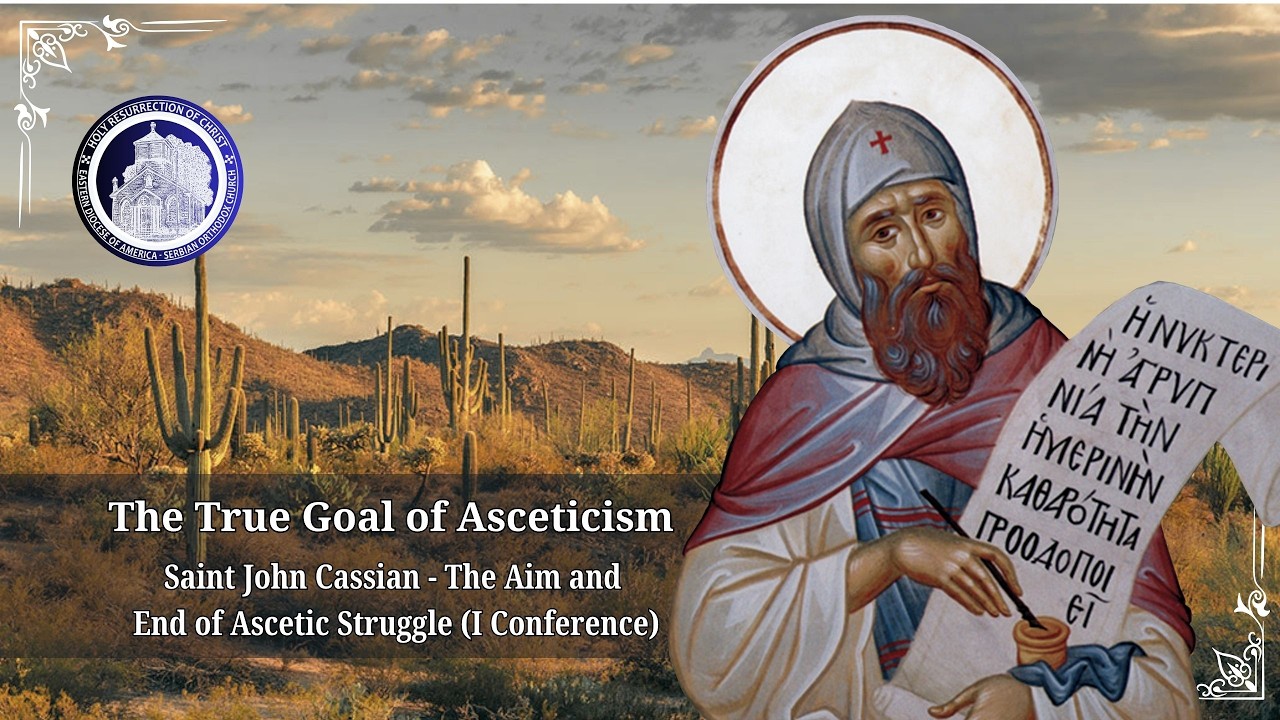
The True Goal of Asceticism: Purity of Heart

The True Goal of Asceticism: Purity of Heart 4:34

This post presents an outline from Saint John Cassian's First Conference in the Philokalia (Volume II), explaining the purpose and structure of the ascetic struggle. Cassian teaches that every craft has an aim (scopos) and an end (telos); the ascetic life is no different. Its ultimate end is the Kingdom of God, and its immediate, indispensable goal is purity of heart.

Without purity of heart, the end cannot be attained. Saint Paul confirms this, identifying the fruit of the Christian life as holiness and the end as eternal life, thereby equating the goal with purity of heart.

All ascetic practices — fasting, vigils, solitude, scripture reading, poverty, and the desert life — are means to preserve purity of heart, not ends in themselves. Cassian emphasizes that if purity of heart is kept intact, the omission of a particular discipline does not cause great harm. Conversely, fulfilling every external discipline while losing purity of heart yields no spiritual profit.

Therefore, the monk or Christian must constantly direct every action toward this goal, correcting any deviation, lest all labor be in vain. The teaching calls for a reorientation of ascetic effort: the practices serve the heart's purification, and the heart's purity serves the Kingdom.

  • Asceticism has an aim (purity of heart) and an end (the Kingdom of God), just as every craft has a purpose and a final goal.
  • Purity of heart is the immediate goal without which the ultimate end cannot be reached; St. Paul links this to holiness and eternal life.
  • Fasting, vigils, solitude, reading, and poverty are means to preserve purity of heart, not perfections in themselves.
  • If purity of heart is maintained, missing a lesser discipline is not greatly harmful; but keeping all disciplines while losing purity profits nothing.

Key moments: 0:120:431:14

Holy Resurrection YouTube

Understanding the Fall: An Orthodox Perspective on Humanity's First Sin

Understanding the Fall: An Orthodox Perspective on Humanity's First Sin 1:24:01

This post announces the second lecture in a catechetical series based on Dr. Clark Carlton's book "The Life," focusing on the Fall of Man. The lecture explores fundamental Orthodox theological questions: what constitutes humanity's fall, whether our current experience of the world reflects God's original intention, and how the Eastern Orthodox Church understands the entrance of death into creation.

The session examines the sin of Adam and Eve as our first-formed parents, seeking to illuminate the meaning of human life in light of this primordial event. The presentation is part of an ongoing educational ministry that offers systematic Orthodox catechism through recorded lectures, available on podcast platforms. The post also includes appeals for material support to establish a permanent church building, inviting monthly contributions or one-time gifts through various donation channels.

Additional links direct viewers to an online shop, a Substack newsletter, and social media presences. The content reflects a parish-based teaching ministry that combines doctrinal instruction with practical community building, framing both spiritual education and physical church construction as works of grace.

  • Second lecture in a catechism series on "The Life" by Dr. Clark Carlton
  • Examines the Orthodox understanding of the Fall of Adam and Eve
  • Addresses the origin of death and the distortion of creation
  • Connects primordial sin to the meaning of present human existence
Holy Resurrection YouTube

St. Isaac the Syrian on Pride: The Hidden Danger After Spiritual Victory

St. Isaac the Syrian on Pride: The Hidden Danger After Spiritual Victory 10:38

The post presents excerpts from St. Isaac the Syrian's Ascetical Homilies (Homilies 21, 34, 78, 79) compiled in a 2008 Lavra publication. The central theme is pride's insidious nature: it often strikes after a person has undertaken great spiritual labors and acquired virtues. St. Isaac warns that when God withdraws His help, the soul discovers its supposed strength was actually divine providence, for human nature alone cannot conquer the passions.

The martyr Theodore serves as an example: during torture, a youth (Christ or an angel) wiped his sweat, strengthened him, and brought refreshment, illustrating that God's grace secretly sustains every true feat. The tragedy comes when one forgets this and attributes spiritual dignity to oneself. Such ingratitude leads to God's withdrawal of grace, a catastrophic fall into impurity, and demonic temptations.

St. Isaac lists specific afflictions — demonic attacks beyond strength, loss of wisdom, burning lust, anger, delusion, blasphemy, bodily sufferings, and deprivation of divine hope — as diagnostic signs revealing the depth of hidden pride. The discussion underscores that the ascetic must continually recognize himself as an instrument through whom God conquers, asking for that same power to give glory to God, lest the sacred ministry become an occasion for pride rather than a gift received.

  • Pride attacks after spiritual labors, testing whether strength is one's own or God's.
  • Human nature cannot overcome passions without divine grace; every victory is God's work.
  • The martyr Theodore's experience shows Christ's hidden assistance in suffering.
  • Forgetting grace and claiming credit leads to God's withdrawal and a fall into impurity.

Key moments: 0:120:441:46