WeOrthodox
EN UA

Ancient Faith

YouTube 8 discussions · Open the original ↗

Ancient Faith exists to carry out the Great Commission of Jesus Christ through accessible and excellently crafted publications and creative media that lead to a living experience of God the Father, through Jesus Christ, in the Holy Spirit. Our mission is to embrace the fullness of the Orthodox…

Ancient Faith YouTube

Desire or the Holy Spirit: Fr. Stephen De Young on Why No One Truly Seeks the Priesthood's Burden

Desire or the Holy Spirit: Fr. Stephen De Young on Why No One Truly Seeks the Priesthood's Burden 7:40

In this talk, Fr. Stephen De Young reflects on St. Paul's warning that not many should presume to become teachers, applying it to the contemporary pursuit of ordained ministry. He observes that people often seek the priesthood out of desire—for power, money, status, or as an escape from sin—rather than out of a genuine calling. Some imagine that dedicating themselves to the Church will free them from their passions, yet experience shows struggles often intensify instead.

Fr. Stephen stresses that no one naturally desires the true burden of priesthood: bearing the sins of the community and giving an account at the last judgment for every soul served. More broadly, he argues that following desire never fills our inner lack; obtaining what we want only leads to chasing the next thing, ending in despair.

The alternative he proposes is cultivating sensitivity to the Holy Spirit—doing what we already know is right, since the commandments are written on our hearts. This sensitivity is fostered through prayer and through doing difficult things even when we do not feel like it. He closes with advice once given to him by a Roman Catholic priest: try everything else first, because if God is calling you to the priesthood, you will find yourself unable to do anything else.

He notes this principle extends beyond clergy to every form of priesthood, including parents and community leaders. The discussion, drawn from an Ancient Faith Ministries podcast, centers on discerning vocation, the deceptive nature of desire, and the practical life of obedience and prayer by which one learns to hear the Spirit rather than one's own appetites.

  • St. Paul's warning that not many should presume to be teachers remains relevant: many still seek ordained office presumptuously.
  • People often pursue priesthood for power, money, or as an escape from sin, but no one desires its real burden—bearing the community's sins and answering for them at the last judgment.
  • Following desire never brings fulfillment; getting what we want only leads to pursuing the next thing and eventually despair.
  • The alternative is sensitivity to the Holy Spirit: doing what we know is right, nurtured through prayer and doing hard things even without feeling like it.

Key moments: 0:000:301:01

Ancient Faith YouTube

Forming the Heart: Benjamin Lyda on Orthodox Education and the St. Nectarios Educators Conference

Forming the Heart: Benjamin Lyda on Orthodox Education and the St. Nectarios Educators Conference 38:59

In this episode of Ancient Faith Presents, Melanie interviews Benjamin Lyda, founder of the Scriptorum Writing curriculum and co-host of the St. Nectarios Orthodox Educators Conference. Benjamin recounts his journey from evangelical Protestantism to Orthodoxy—sparked by studying church history some twenty years ago—and his two decades in education, including teaching grades four through twelve, directing Shakespeare plays, helping found a school, and now training teachers through his consulting organization Living Classical.

The heart of the conversation is his conviction that the first priority of education is forming the heart toward Christ. Using the metaphor of Pegasus, he explains that education can aid the ascent toward God but cannot complete it; only Christ and the Holy Spirit convert hearts, and educators must seek what St. John of Kronstadt called the door to a child's heart.

The discussion critiques both progressive education, which rests on pragmatic and materialistic assumptions about the human person, and much of what passes for classical education today, which often shares the same pedagogy while wearing different clothes. Benjamin cautions parents against sending children to public schools without critical reflection—not out of conspiracy thinking, but because teachers' unexamined assumptions inevitably come through.

He also addresses practical questions: co-ops and parish schools can learn from one another, homeschoolers can use good Christian materials even when not explicitly Orthodox, and loving Christ and loving to learn matter more than standardized tests. Drawing on Charlotte Mason, he notes that atmosphere, habits, and living ideas—familiar from Orthodox liturgical life—are the tools that shape the heart.

The episode closes with details on the online St. Nectarios Orthodox Educators Conference (November 6-7, 2026), featuring speakers such as David Hicks, Andrew Kern, and Josh Gibbs, with recordings available to registrants.

  • Benjamin Lyda's path from evangelicalism to Orthodoxy and two decades of teaching shaped his conviction that education's first task is forming the heart toward Christ.
  • Education can aid the ascent to God but cannot accomplish conversion—only Christ and the Holy Spirit can, so educators must find the door to a child's heart.
  • Progressive education rests on materialistic assumptions about the human person, and much modern 'classical' education shares the same pedagogy.
  • Practical guidance for families: co-ops and schools can learn from each other, and loving Christ and loving learning matter more than test scores.

Key moments: 0:353:106:49

Ancient Faith YouTube

Teaching Children Floral Arts for Orthodox Worship

Teaching Children Floral Arts for Orthodox Worship 35:32

In this episode of Mirror of Paradise, Hannah Hunt demonstrates how to involve children in creating floral arrangements for Orthodox liturgical use, turning the craft of flower wiring into a formative spiritual activity. The session centers on wiring hyacinths and carnations, constructing a crown for the myrrh-bearing girls' Holy Friday procession, and building a garland for an icon frame.

Hannah begins by referencing the Wisdom of Solomon on perceiving the Creator through creation's beauty, framing the work as a way to foster children's love for God through hands-on engagement with the natural world. Hyacinths are introduced as a spring flower rich in symbolism — their fragrance and form evoking the beauty of the New Jerusalem, majesty, and divine authority — making them especially fitting for Holy Week.

Children Colt and Adelaide actively participate, wiring individual hyacinth florets on 22-gauge wire for placement on the tomb of Christ, the royal doors, or processional lanterns. Hannah then crafts a hyacinth crown for Adelaide, explaining the tradition of myrrh-bearing girls who, dressed in white and crowned, process around the epitaphios on Holy Friday sprinkling petals.

The demonstration continues with two wiring methods for carnations — a simple pick and a traditional wired stem using floral tape — noting carnations' durability out of water. Spray roses are prepared by removing guard petals and sepals before taping, allowing wired stems to be bent outward for better visibility. Finally, Hannah constructs a garland by hand on a heavy bind-wire spine for shape control, using lemon leaf, leather leaf, ming fern, cedar, wax flower, and wired roses in a bespoke English garden style.

The garland is attached to a custom PVC pipe frame fitted to an icon with felt pads for protection, secured with chenille stems for reusable, adjustable fastening. Throughout, the emphasis remains on forming children in the liturgical life of the Church through beauty, symbolism, and shared labor.

  • Children actively wire hyacinths and carnations for liturgical use, connecting craft to worship.
  • Hyacinths symbolize the New Jerusalem, majesty, and divine authority, fitting for Holy Week.
  • A hyacinth crown is made for the myrrh-bearing girls' Holy Friday procession tradition.
  • Two wiring techniques for carnations and spray roses are taught for durability and presentation.

Key moments: 0:321:032:07

Ancient Faith YouTube

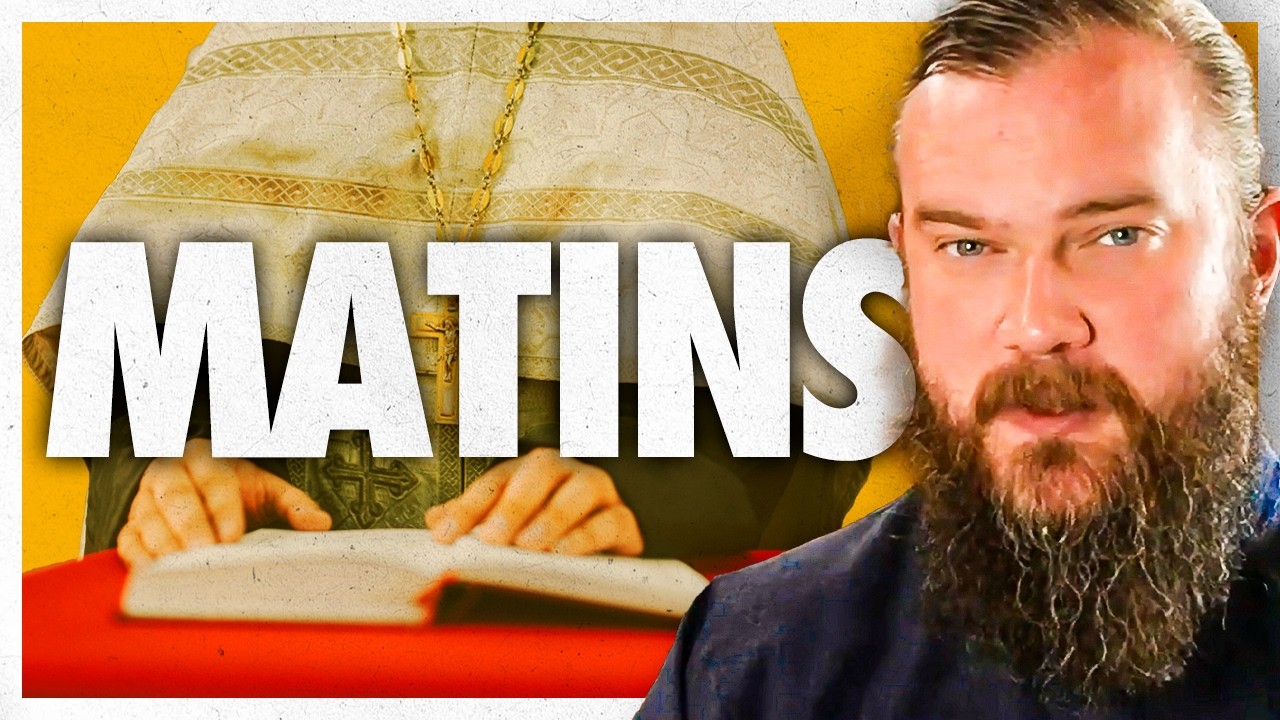
Matins: The Orthodox Morning Watch from Darkness to Resurrection Light

Matins: The Orthodox Morning Watch from Darkness to Resurrection Light 35:54

Deacon Seraphim Richard Roland walks through the structure and theology of Matins (Orthros), the Orthodox morning watch service. He begins with the Six Psalms (Hexapsalmos) chanted in a dark church while the priest prays the Twelve Morning Prayers before the closed holy doors. These psalms trace a descent into despair — enemies, sin, thirst, the pit — and an ascent to mercy, forgiveness, and morning guidance, mirroring the pattern of salvation.

The deacon then proclaims "God is the Lord" (Psalm 117), announcing Christ's revelation in the darkness. Troparia of the day and Kathismata with Sessional Hymns follow, interpreting the Psalter through the feast or resurrection. On Sundays, one of the eleven Resurrection Gospels is carried into the nave for veneration, making the faithful witnesses to the risen Christ; the Gospel book is placed in the center, showing word and sacrament as complementary revelations.

Psalm 50 leads into the Canon, a poetic structure built on nine biblical odes that teaches a Christological reading of the Old Testament. The Magnificat is sung at the ninth ode, followed by the Praises (Psalms 148–150) and the Great Doxology — "Glory to Thee who hast shown us the light" — summoning all creation into the light of the Resurrection.

Deacon Seraphim notes key differences in practice: Greek and Antiochian traditions serve Matins before Sunday Divine Liturgy, while Slavic practice joins it to Vespers as the All-Night Vigil on Saturday evenings. He roots the service in the biblical tradition of meeting God in the night — Israel at the Red Sea, the psalmist at midnight, Christ praying before dawn, the myrrh-bearers at the tomb — and encourages participation in Matins as essential preparation for the Divine Liturgy. Handouts and further resources are provided for deeper study.

  • Matins begins in darkness with the Six Psalms (Hexapsalmos) read in stillness, moving from despair to hope in God's mercy.
  • The service proclaims "God is the Lord" and on Sundays brings a Resurrection Gospel into the midst of the people for veneration.
  • The Canon teaches a Christological reading of the Old Testament through nine biblical odes, culminating in the Magnificat.
  • The Praises and Great Doxology conclude the service, ushering the faithful from night into the light of Christ's resurrection.

Key moments: 0:011:333:06